Identity lives outside the org directory
Standalone accounts and per-team logins sit outside SSO, so joiners and leavers are managed by hand and access never reflects the directory of record.
Generated files, runtime feedback, previews, and release controls stay in one workspace.
Enterprise rollout for governed engineering teams
Bring E-Code to a whole engineering organization through a controlled rollout. Scope SSO and SCIM integration, role boundaries, audit export, deployment approvals, and runtime topology against your environment, then validate each production control before enablement.
Start from the controls your organization already requires. Identity, roles, audit export, and deploy governance stay visible as the rollout expands across teams.
 Open live preview
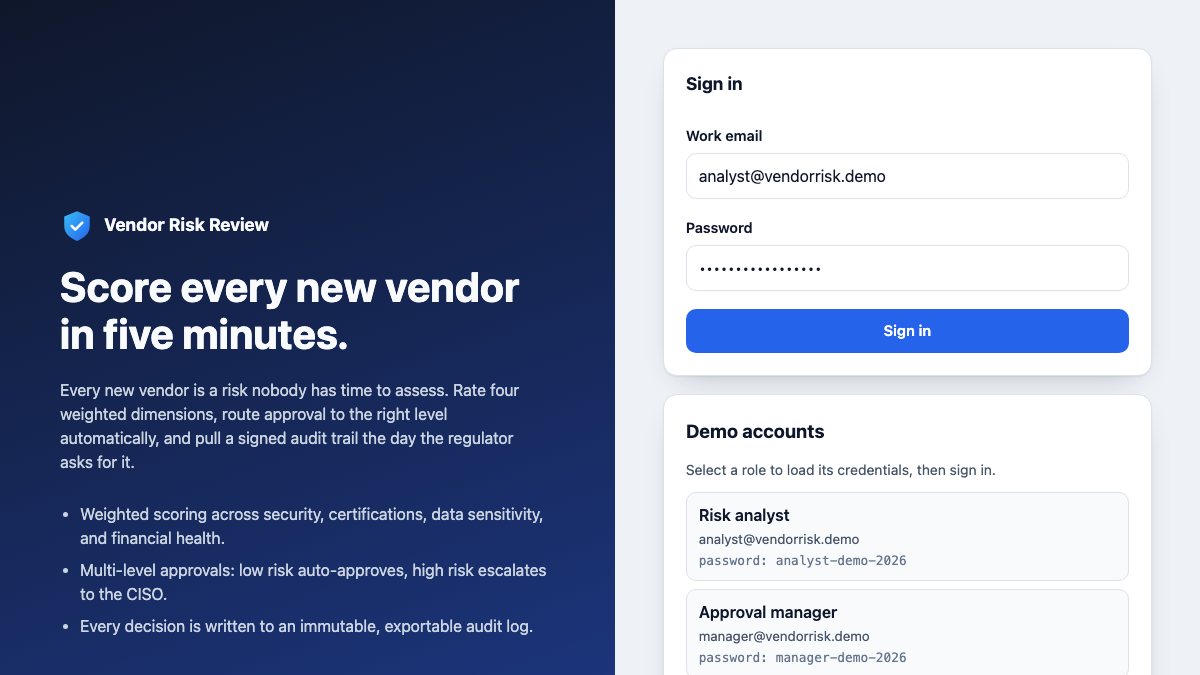
A certified full-stack workflow with authentication, approvals, weighted risk scoring, and an audit trail.
REAL APPS · OPEN THE PREVIEW
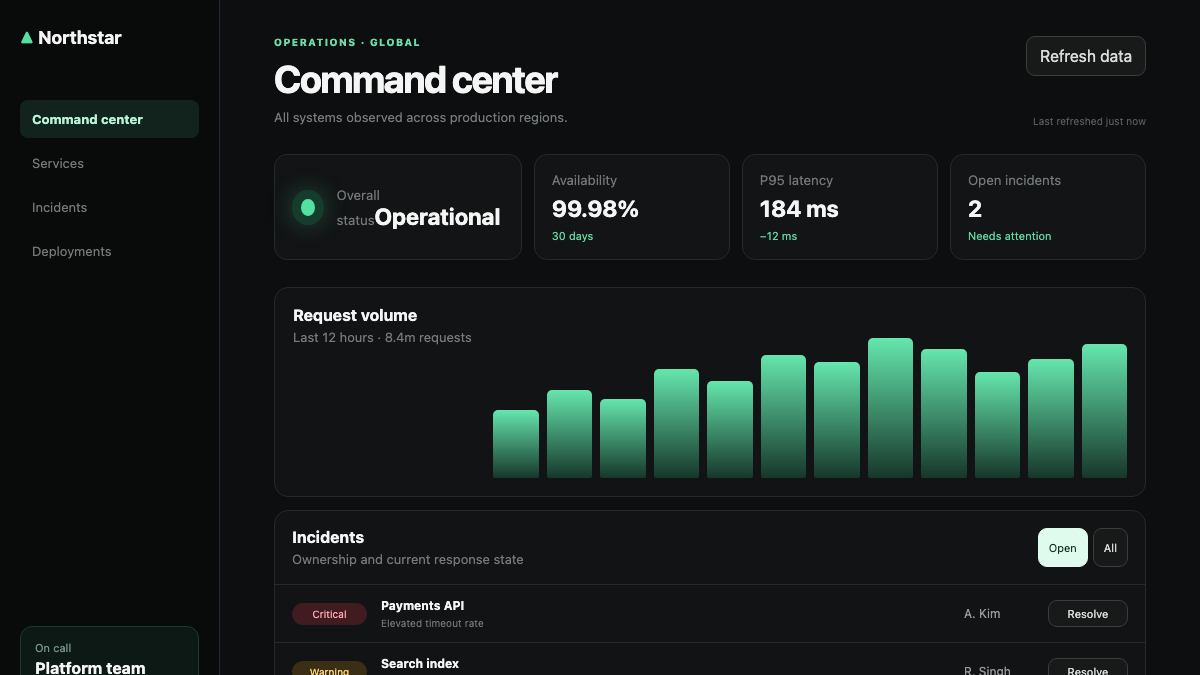
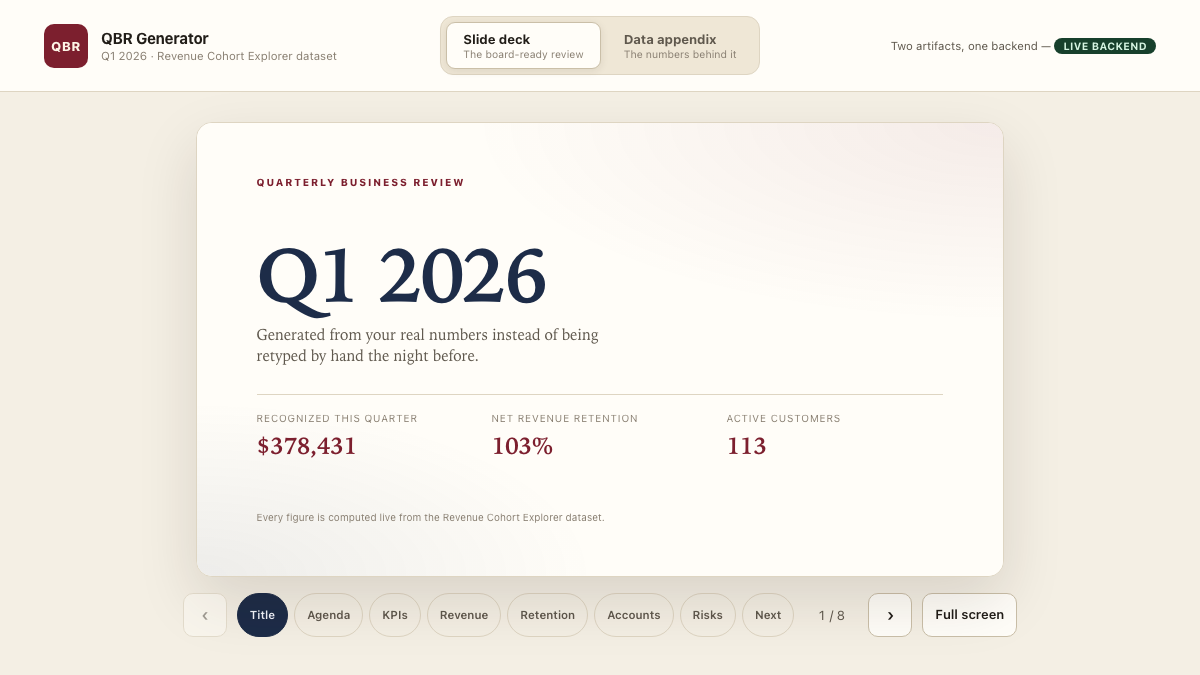
Every image below is a capture of an executable E-Code demo application. Open the preview to test the interface yourself.
 Open live preview
A production operations dashboard with service health, incident ownership, and deployment status.
 Open live preview
A certified executive reporting app with a live backend, slide deck, and shared data appendix.
From ungoverned adoption to a controlled rollout
A single team can adopt a build tool overnight, but an organization cannot. Security, platform, and compliance need central identity, role boundaries, an audit trail, and control over where code runs and how it ships — before adoption becomes a liability.
Standalone accounts and per-team logins sit outside SSO, so joiners and leavers are managed by hand and access never reflects the directory of record.
Without role boundaries and an exportable audit trail, no one can answer who changed what, who approved a deploy, or who can reach which environment.
When any workspace can run anything and ship anywhere, platform teams lose the runtime isolation and deploy controls their environment requires.
The E-Code enterprise rollout maps identity integration, roles, audit export, runtime requirements, and deployment approvals to your existing controls. Configuration and tenant validation precede production enablement.
One request frames the rollout
The request below reads like a note from a platform lead. The four items map what a governed rollout provides — identity, governance, controlled delivery, and support — over real infrastructure, not a locked template.
Roll out E-Code across our engineering org with SSO, role-based access, audit export, and governed deployments.
E-Code includes SAML/OIDC and SCIM configuration paths. Your identity metadata, role mapping, joiner/leaver behavior, and tenant connection are validated before they govern production access.
Role-based access scopes build, review, deploy, and administration actions. The rollout verifies which identity, access, and deployment events enter the audit export required by your review process.
Runtime isolation is an architecture and rollout decision, not a default entitlement. Deployment roles and approval paths are configured and tested against the environments in scope.
A guided rollout plan, onboarding for teams, and a support path help the organization adopt E-Code in stages rather than all at once.
What your organization receives
Every generated project exposes what teams review, what platform owners still connect, and which publishing path applies. Enterprise controls remain visible around the work without turning a demo into proof of production readiness.
Teams receive real components, routes, styles, and configuration files that reviewers inspect in the workspace and export for their versioning and delivery process.
Schemas, adapters, environment references, and secret names stay visible in the project. Databases, identity providers, and internal services still require approved connections and tenant validation; credentials never belong in generated source.
A compatible build runs in Preview across desktop, tablet, and mobile so product, platform, and security reviewers inspect the same current interface before a release decision.
Supported static builds follow E-Code’s guided publishing flow. Enterprise roles, approval points, and target-environment checks remain explicit rollout configuration.
A supported static release receives a live E-Code-hosted URL. Projects that depend on server processes remain exportable and need an agreed runtime, networking, secrets, and operational model.
A team continues the Agent conversation to request a policy, interface, or workflow change, then reviews the updated files, diff, and running Preview before accepting it.
Built for governed organizations
The Enterprise path keeps identity, access, audit, and delivery in one administrable workflow over real code.
Use the SAML/OIDC configuration path and validate your provider’s metadata, claims, and role mapping before production use.
SCIM synchronizes supported membership changes after tenant configuration and live provisioning tests succeed.
Role boundaries scope who can build, review, ship, and administer.
Verify exported identity, access, and deployment event coverage against the evidence your review process requires.
Assess a private runtime topology against networking, secrets, capacity, operations, and support requirements before adding it to scope.
Configure and test roles and review points around supported release paths without hiding the underlying source.
Who rolls it out
From a platform team standardizing tooling to a regulated org tightening access, the same controls frame a governed rollout.
Standardize how the org builds and ships under central identity and deploy controls.
Validate SSO, role boundaries, and audit evidence against internal access and review requirements.
Evaluate E-Code through documented identity, audit, runtime, and deployment requirements without inferring a certification from this page.
Onboard many teams in stages with roles, provisioning, and governed delivery.
Common questions
What a governed E-Code rollout provides, and where its boundaries are.
E-Code includes SAML/OIDC configuration and SCIM provisioning paths. Production support for your organization is confirmed only after provider metadata, claims, role mapping, provisioning, and deprovisioning pass validation in your tenant.
The enterprise scope includes audit export, with event coverage and destination verified against your review workflow. The inline demonstration on this page uses fictional data and proves no connected export.
We describe SSO, provisioning, audit export, and runtime isolation as capabilities you plan and administer. We do not assert a specific compliance certification on this page — talk to us about your requirements.
This page promises private-runtime planning, not an enabled private environment. Topology, availability, networking, operations, support, and commercial scope are confirmed during the rollout before any implementation commitment.
The rollout configures roles and review points for the supported deployment paths, then tests who may release and how approval proceeds in the environments included in scope.
Enterprise rollout for governed engineering teams
Map identity, roles, audit export, runtime requirements, and deployment approvals to your environment, then validate every production control before enablement.